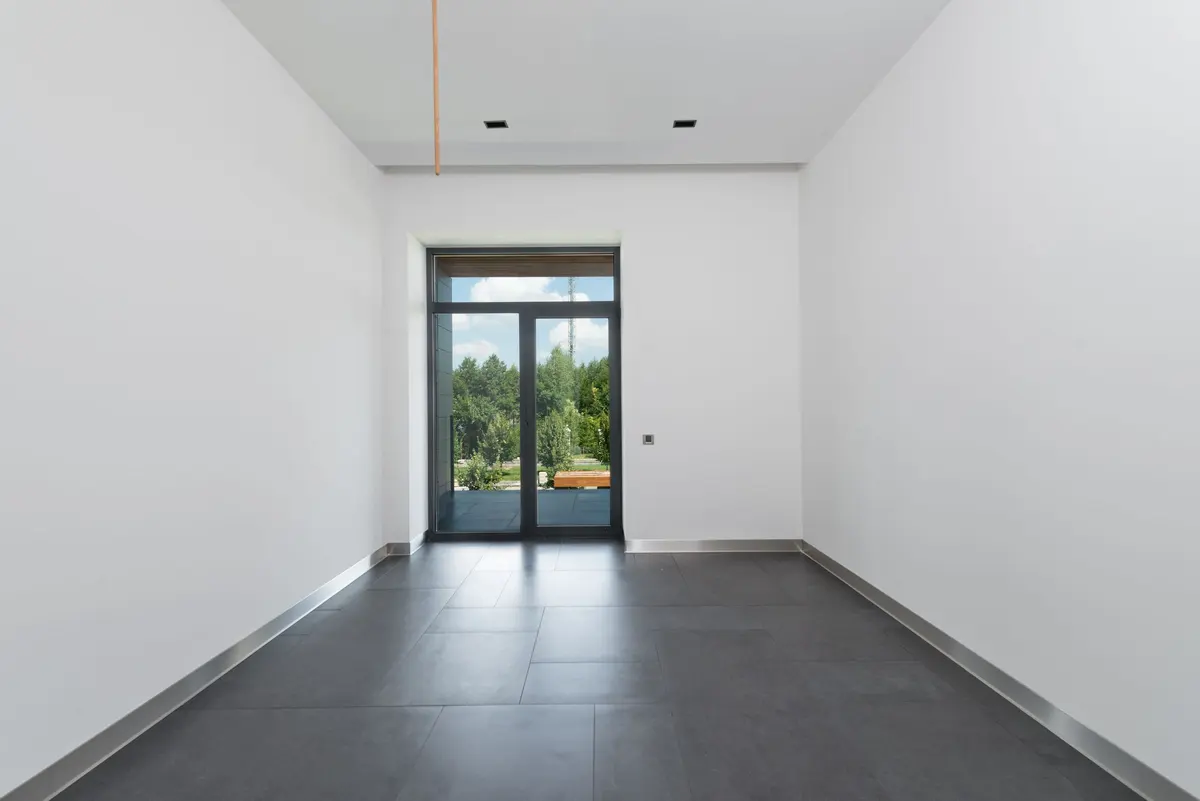
Forney was the fastest-growing city in the country between 2020 and 2024, and the commercial space followed the rooftops. Along US 80 and out toward I-20, in the Rockwall retail corridors and through the older stock in Terrell and Kaufman, there is a lot of building being fitted out, refitted, and taken over by a new tenant.
Commercial flooring is a different specification from residential, and the differences are not about looks. Here is what actually changes.
Commercial-grade is a measurement, not an adjective
Any product can be described as commercial. The things that make it true are specific and worth asking for by name.
**Wear layer.** On luxury vinyl this is measured in mils, and it is the clear top layer taking all the abuse. Residential product commonly runs 6 to 12 mil. Commercial specification typically starts around 20 mil and goes up. That single number predicts more about how a floor survives than anything else on the spec sheet.
**Traffic rating.** Commercial products carry a classification for light, moderate or heavy commercial use. A waiting room and a warehouse aisle are not the same environment and should not get the same product.
**Carpet construction.** Commercial carpet is a different animal from residential — low, dense loop pile rather than plush, built to take rolling loads and chairs rather than bare feet. Broadloom or tile, and the tile version is worth understanding for reasons below.
**Slip resistance and fire rating.** Both are specified rather than assumed in a commercial fit-out, and both may be inspected.
If a quote says commercial-grade without naming any of those, it has not told you anything yet.
What suits which kind of space
**Offices and professional space.** Carpet tile through the open areas and hard surface in corridors and break rooms is the standard combination, and it earns its place. Carpet tile absorbs sound, which matters more in an open office than anything else, and a damaged tile is swapped individually rather than reflooring a room around occupied desks.
**Medical, dental and veterinary.** This is where sheet vinyl comes into its own. Heat-welded seams give you a continuous, cleanable surface with nowhere for anything to get into, and it can be coved up the wall to remove the floor-wall junction entirely. It is specified for cleanability, and the specification is the point.
**Restaurants and food service.** Two different problems in one building. Front of house wants durability that still looks like hospitality — tile or heavy-wear luxury vinyl. Back of house wants slip resistance under grease and water, drainage that works, and a surface that survives daily cleaning chemistry. Do not let anyone spec the two the same way.
**Retail.** High traffic on defined paths, and appearance is part of the product. Wear layer matters, and so does how the floor handles the point loads from fixtures and racking that never move.
Rental houses and multi-family buildings run on their own logic. The floor is judged after the third tenant rather than on install day, and the turn window matters more than the installation. Flooring for rental properties covers that side in detail.
**Light industrial and shops.** Loads rather than footsteps. Forklifts and pallet jacks concentrate weight onto small hard wheels, racking legs press into the same square inch for years, and things get dropped. In much of that space the concrete slab is the floor, and sealing or coating it beats covering it. Floor prep is most of that job.
Downtime is the number that actually decides the job
Most commercial flooring conversations we have are really scheduling conversations. The business cannot stop, and the question is how much of the building has to be out of use at once.
The answer is almost never close the building. It is to divide the space into zones that can be shut independently and move through them one at a time. A good zone has a natural break, does not sit between customers and an exit, and does not stop the business functioning when it is closed. Draw those badly and a phased job turns into a shutdown.
The thing that constrains the schedule is not installation time — it is cure and set time, and it does not care what hour it is. Adhesives need to set. Coatings need a genuine cure before traffic. Self-leveling compound used to correct a slab has to dry before anything goes over it, and that is frequently the longest item on the schedule.
So the useful question for any contractor is not how long will it take to install. It is **when can we use this room again**. Those are different numbers, and the second one is the one your business runs on. It also changes the material choice: a floating floor can be walked on immediately, a glue-down cannot, and when a space has to be back in service the next morning that difference decides the product.
After hours, and what it is worth
Working outside your hours is straightforward and it carries a labor premium. Whether it is worth paying depends on the building.
For retail and restaurants it usually is, because the trading day is the whole business and an overnight window is genuinely usable. For a larger office, phasing daytime work through unoccupied areas often gets you to the same place without the premium. It is worth pricing both ways rather than assuming.
The slab, again
Nearly every commercial building around here is on a slab, and everything in what a North Texas slab does to a floor applies with more force in a commercial fit-out, because the areas are bigger and the tolerances are tighter.
Moisture testing is not optional before a glue-down or a coating. Flatness is not optional under a rigid floor over a large open area, where a dip that would be invisible in a bedroom becomes obvious across a showroom. And in an older building there may be layers of previous flooring and old adhesive to deal with — which is removal and demolition work, and it belongs in the schedule rather than as a surprise.
Where floors fail in commercial buildings
Not in the middle of the room. At the edges.
Entrances, where weather, grit and rolling traffic all arrive at the same point — and where a proper entry matting system does more for the life of the whole floor than any product upgrade further in. Transitions between materials and between heights. Drain surrounds in any wet area. And control joints in the slab, which move and will tear a rigid floor that bridges them without being detailed for it.
When we are called to look at a commercial floor that has failed early, it is nearly always one of those four, and nearly always because the detail was treated as trim rather than as the hardest-working part of the installation.
For a home rather than a business, how to choose a flooring company in Forney and Kaufman County covers the same questions from the homeowner's side.
What we need to quote it properly
A floor plan, even a rough one. Your honest hours, meaning when the building is genuinely empty rather than when the sign says closed. Which areas cannot be out of use at the same time. Any fixed dates — an inspection, a busy season, a lease start.
And someone who can make a decision on site. Occupied-building jobs meet surprises, and waiting two days for an answer costs more than the surprise did.
We handle commercial flooring across Forney, Rockwall, Terrell, Royse City, Mesquite, Garland and the rest of the area — our showroom is at 10 Mustang Court in Forney. Walk the space with us and you will get a zone-by-zone schedule before the work starts rather than after. Book a site visit.