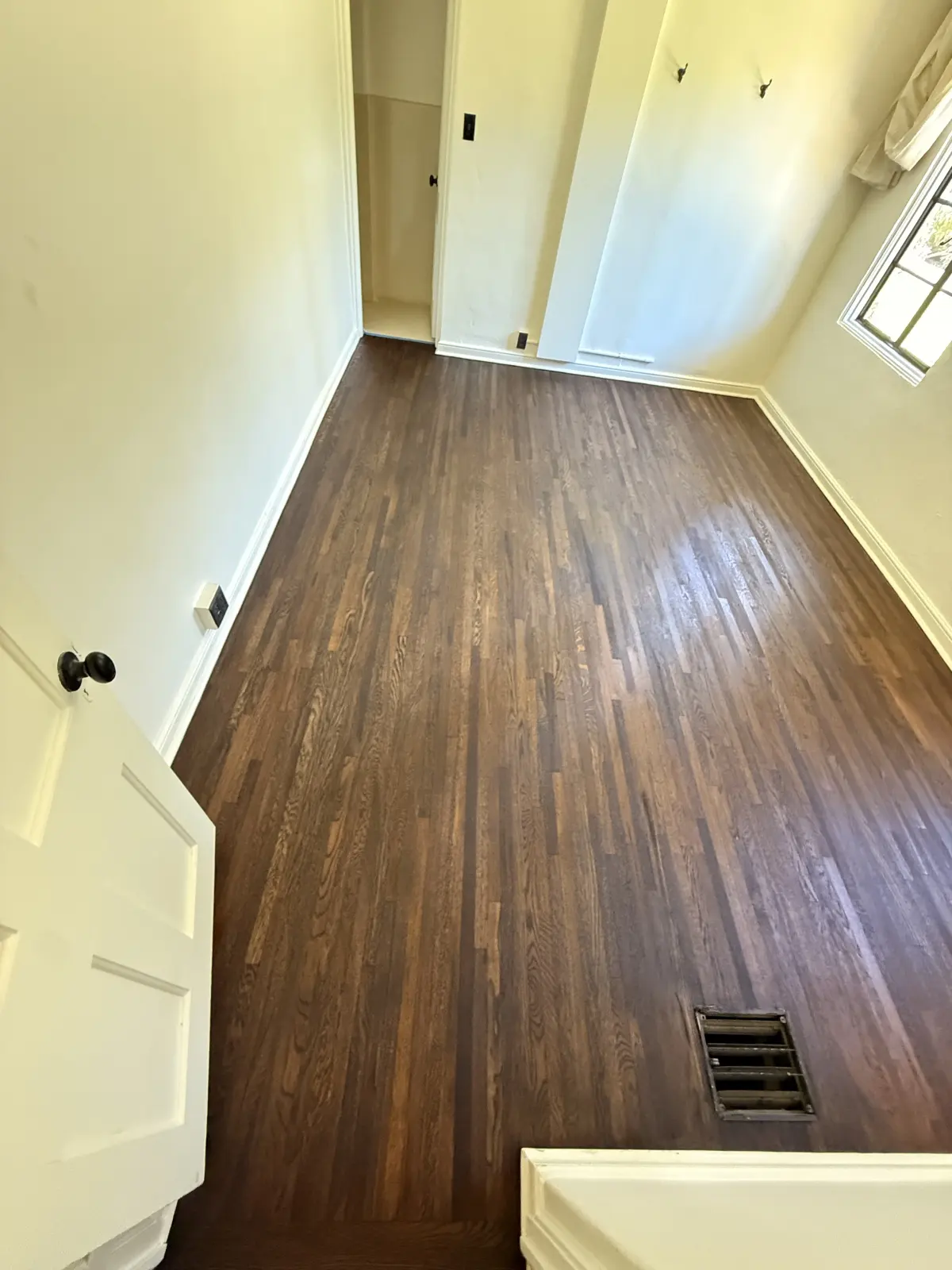
Nobody budgets for floor removal. People price the carpet or the plank, picture it going down, and then the estimate arrives with a line for taking out what is already there. On a North Texas house that line can be small or it can be a real share of the job, and the difference is almost entirely about what the old floor is and what it is stuck to.
This is how removal is priced, floor by floor, what makes tile on a slab the expensive one, and how to make sure the number you are comparing is complete. If you want the step-by-step of what actually happens on demo day, what happens to your old floor covers that. This one is about cost.
Why removal costs what it does
Three things set the price of taking out a floor: how it is attached, how much it weighs, and what is left behind when it is gone.
A floor that is stapled or stretched comes up quickly and leaves a clean surface. A floor that is glued leaves adhesive that has to be scraped or ground off. A floor that is set in mortar leaves a layer of thinset bonded to the concrete, and that layer is the job.
Weight matters because everything that comes out has to be carried to a trailer and paid for at the landfill. A room of carpet is a few bags. The same room of tile is a load.
And almost every house we work in, from Forney out to Rockwall and down to Kaufman, sits on a concrete slab. That is the surface we are taking things off, and concrete is unforgiving: whatever adhesive or mortar was used has cured to it for years.
Carpet and pad: the cheap one
Carpet is stretched over tack strip and stapled at the edges, with a foam pad underneath that is usually glued in spots or stapled. Pulling it is fast. A crew cuts it into strips, rolls them, pulls the pad, pries up the tack strip and scrapes off any pad adhesive.
On a slab the surprise is what the pad left behind. Older pad breaks down into a crumbly layer that has to be scraped, and some builders glued pad down heavily. That adds time but not much.
Carpet removal is typically priced by the square foot at the low end of any removal scale. On many jobs the removal is a small fraction of the cost of the new carpet going in. If you are replacing carpet in a bedroom with new carpet, it is the part of the quote you will notice least.
Floating floors: laminate and click vinyl
Floating floors are not attached to the slab at all. They lock to each other and sit on an underlayment, held in place by the baseboard and their own weight. Removal means pulling the trim, unclicking the planks and rolling up the pad.
This is the other cheap removal. The one complication is old laminate that has swelled from a leak, which no longer unclicks and has to be broken out, and the occasional floor that turns out to be glued at the perimeter. Neither changes the price much.
Glued vinyl: it depends entirely on the glue
Sheet vinyl and glue-down plank are where the range opens up. The vinyl itself peels up, sometimes in one piece, sometimes in strips. What matters is the adhesive underneath.
A pressure-sensitive adhesive on a newer glue-down plank scrapes off without much fight. Old sheet vinyl in a 1970s or 1980s kitchen, the kind you find under two later layers in a Kaufman or Terrell house, is often down on a hard-set or cutback adhesive that has to be mechanically ground. Cutback in particular can be a problem: in houses of that era it sometimes contains asbestos, in which case the safe answer is to encapsulate it under a new floor rather than grind it, and we will tell you that rather than take a chance.
The other cost driver is the felt backing. Some vinyl separates from its backing when you pull it, leaving a paper-thin layer bonded to the slab that has to be removed separately. It looks like nothing and takes hours.
Price glued vinyl removal in the middle of the range, with the honest caveat that we cannot tell you which end until we lift a corner.
Tile on a slab: the expensive one, and why
Tile is set in thinset mortar directly on the concrete. Breaking the tile out is the noisy, fast part. Then there is the thinset, which has bonded to the slab as hard as the slab itself, and it has to come off or be ground flat before anything new goes down. Thin plank telegraphs every ridge left behind, and wood or new tile cannot sit on an uneven bed.
That grinding is done with dust-controlled equipment and it is slow. It is also the difference between a removal that costs a little and one that is a meaningful part of the project. Tile removal is consistently the highest per-square-foot removal cost in a house, and a large tiled main floor can put it into four figures on its own.
Two things push it higher: tile that was set over a mud bed or a second layer of tile, which doubles the material coming out, and tile in a house built before the 1980s where the setting bed may be thick and the tile may be ceramic that shatters into small pieces. Two things bring it down: tile that is already loose, which comes up in sheets, and a decision to float a new floor over it, which we come to next.
Hardwood: nailed is easy, glued is not
Solid hardwood nailed to a plywood subfloor, which you find in the pier-and-beam houses around downtown Terrell and old Forney, pries up board by board. It is labor but it is straightforward, and the plywood underneath is usually reusable once the nails are pulled.
Engineered wood glued to a slab is a different job. The boards splinter rather than lift, and the urethane adhesive underneath is among the hardest things to get off concrete. It is ground, not scraped. Price it near tile.
If your existing hardwood is sound, the cheapest removal is not doing it. Refinishing an existing floor costs less than removing it and installing new, and in many older houses the wood under the carpet is worth saving. We will tell you which you have.
When you can skip removal altogether
A floating luxury vinyl plank can go directly over existing tile or sheet vinyl if the old floor is flat, sound and fully bonded. That eliminates the most expensive removal in the house and shortens the job. It is a common answer in a Rockwall or Heath house with a tiled main floor that is dated but perfectly solid.
The trade-offs are real. The floor height rises, which shows at exterior doors, at the dishwasher opening and at the transition into carpeted rooms. Hollow spots under the old tile will crack the new floor above them, so we tap every square foot before agreeing to it. Grout lines wider than a plank can bridge need skimming first. And it only works with a floating floor: nothing gets glued or nailed over old tile.
When it works, it saves the largest single line on the quote. When it does not, we say so.
What else lands in the removal line
- **Disposal.** Everything that comes out goes to a landfill that charges by weight. Tile and mortar are heavy; carpet is not.
- **Baseboard and trim.** Floating floors need the base pulled or the shoe mold removed and reinstalled. Careful removal that saves the trim costs more in labor and less in material than replacing it.
- **Appliances and fixtures.** A refrigerator, range and washer come out; a toilet comes off if the bathroom is being done. Built-in cabinets and islands stay, and the floor is cut around them.
- **Subfloor prep.** Strictly a separate line, but it lives next to removal because you only find out what the slab needs once the old floor is gone. Grinding high spots and filling low ones is what makes a floating floor quiet and a glued floor stay down. A quote that shows no prep on an older slab has simply not looked.
How to keep the number honest
Ask for removal, disposal and prep as separate lines. A quote that folds them into a square-foot rate is not necessarily hiding anything, but it makes comparing two companies impossible.
Ask what happens if the slab under the tile is worse than expected. The right answer is a unit price for extra grinding agreed in advance, not a phone call halfway through.
And ask whether the company looked under the floor before quoting. We lift a corner at the estimate, in the room, because a glued vinyl kitchen and a floating vinyl kitchen look identical from above and cost very different amounts to take out.
What it means for your project
For a single carpeted bedroom, removal is a small line and not worth worrying about. For a whole main floor of tile on a slab, it is a real number, and it is worth asking whether a floating floor over the tile makes sense before committing to demo. For everything in between, the honest answer depends on the glue, which is why the estimate happens in your house and not over the phone.
Removal and haul-away are on every All About Floors estimate as their own lines, and the estimate is free. Book one and we will look under the corner while we are there. If the number ends up larger than planned because of what is under there, financing through Wisetack and Synchrony is available for the whole job.