Most people think of tile as a bathroom floor. In a North Texas slab house, it is also one of the best floors you can run through the living room, the entry and the kitchen in one piece.
Tile is the only floor in the house that does not care about standing water, a dog bowl that tips over, or a west-facing window that cooks the room every afternoon. What it does care about is the slab under it. Here is how to choose it and what has to happen before the first tile goes down, from what we see in Forney, Rockwall, Terrell and Kaufman houses.
Why tile suits a living area here
The reasons have little to do with water.
- A rigid base. Slab-on-grade construction gives tile the solid, unmoving floor it needs, without the bounce a joisted floor introduces.
- No fading. Tile does not lighten under afternoon sun through a west window, where vinyl plank's printed layer slowly does.
- No seasonal movement. It does not swell and shrink between a February morning and an August afternoon, the swing that opens gaps in solid wood.
- Nothing to swell. There is no core and no wear layer, so a spill is a mopping problem and never a replacement.
The trade-offs, said out loud: a dropped glass does not survive it, it stays cool underfoot in January, and tile bonded to a slab is the hardest surface in the house to stand on for a long time. Grout in the walkways darkens over the years, which is why grout gets its own section below.
Porcelain or ceramic
For a main living area, porcelain, in almost every case.
Porcelain is fired hotter and denser than ceramic, with water absorption at or below half a percent. Two terms are worth knowing when you shop:
- Through-body porcelain carries its color all the way through, so a chipped edge does not flash white.
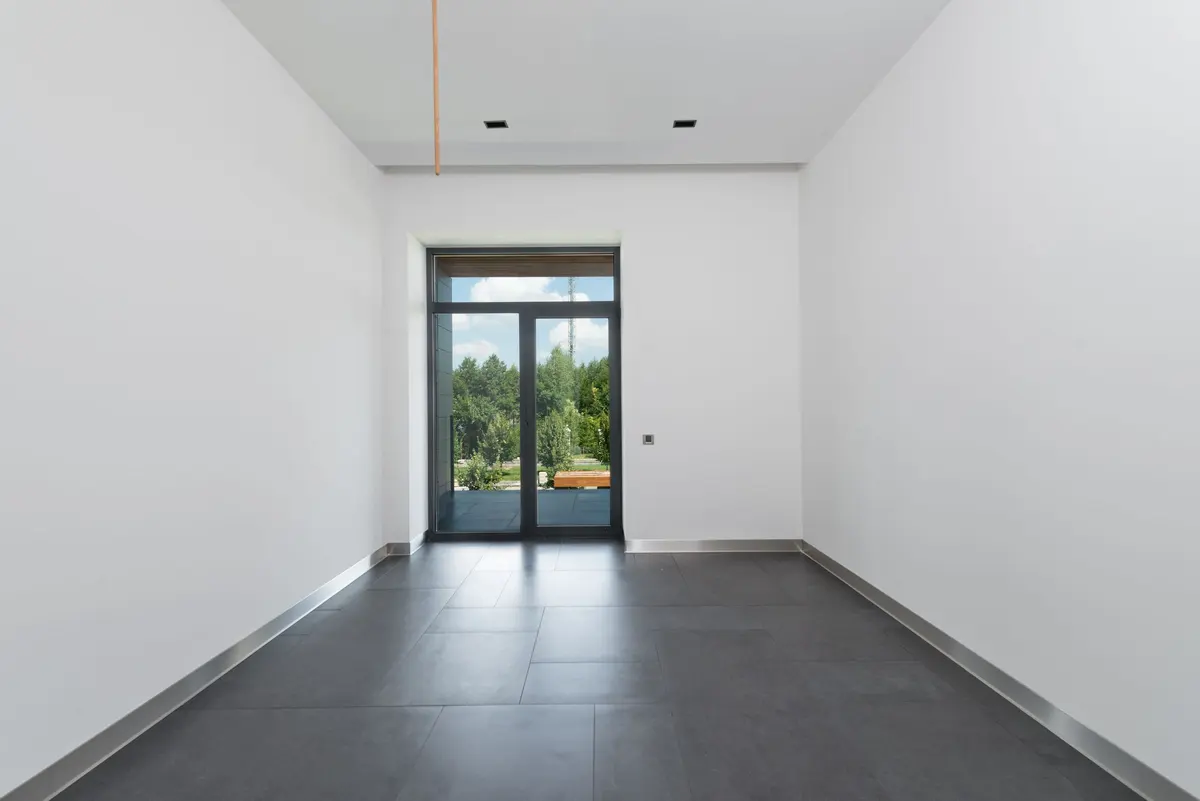
- Rectified porcelain is cut to a precise edge after firing, which is what lets a floor be set with narrow joints and read as one surface.
Ceramic has a softer body, a glazed face and higher absorption. It is a good wall tile and a fine floor in a guest bath. On a floor that takes the whole family and a dog every day, the glaze wears through in the walkway, and a chip shows the paler clay underneath. A cast iron skillet dropped from counter height is enough to do it in a kitchen.
Natural stone, meaning travertine, marble, limestone, slate and granite, is the third option. Every piece is different, so the layout gets dry-laid and blended so one dark box does not land in a single corner. Stone is porous and needs sealing and resealing, and the calcite stones etch dull wherever lemon juice or a vinegar cleaner sits. Wendy, who has fourteen years in tile and design, is candid about which rooms a soft stone belongs in.
Large format and the flatness problem
Large format tile is what makes a living area read calm: fewer grout lines and a floor that looks like one surface. It is also where most tile jobs on a slab go wrong.
A large tile cannot bend to follow a dip in the slab. It bridges it. So the flatness requirement tightens sharply once any edge of the tile reaches fifteen inches, from a quarter inch in ten feet for smaller tile to an eighth of an inch in ten feet for large format. A slab flat enough for a twelve-inch square will produce lippage under a twelve by twenty-four plank, and lippage is what you catch with a bare toe.
That makes prep most of the labor on a large-format floor. High spots get ground down and low spots get filled before any thinset is mixed, and where a whole room is out, it gets a self-leveling underlayment. It is also why wood-look plank tile is set on a third offset rather than a running half bond, because long tiles crown slightly through the middle.
Membranes for a slab on clay
Houston Black clay under most of Kaufman and Rockwall counties swells when it is wet and shrinks when it is dry, and the slab above it moves with the seasons. Tile is rigid and does not want to move at all.
Three details deal with that:
- An uncoupling membrane, a thin dimpled sheet bonded to the slab with the tile set on top, lets the two move independently so a hairline crack in the concrete does not telegraph up through the floor.
- A crack-isolation membrane goes over any existing crack or control joint.
- Every joint in the slab carries up through the finished tile as a soft movement joint filled with sealant, not grout. The perimeter gets the same.
That covers the seasonal movement this clay produces. No membrane survives structural failure, so a slab that is actively separating gets addressed first. Cracked tile on a North Texas slab explains how to tell the two apart.
Grout: width, color and sealing
Grout is the last set of decisions and the one people rush.
- Width follows the tile. Rectified porcelain can run tight joints. Stone, or a handmade-look tile with variation in its edges and thickness, needs a wider joint to absorb it.
- Color is a maintenance choice. Grout matched to the tile makes the floor read as one plane. A contrasting grout draws the pattern on the floor and asks every cut to be perfect.
- Sealing. Porcelain itself needs no sealer, because there is nothing for it to soak into. Cement grout is porous and benefits from sealing in entries and kitchens. A high-performance grout is far less absorbent from the day it cures and takes most of that maintenance off your list.
Grout joints also do real work underfoot. They give a foot edges to catch and give water somewhere to go, which is why slip resistance changes with tile size and why a published slip rating is a starting point rather than the whole answer.
Where the tile stops
In an open-plan house, tile can run unbroken through the entry, kitchen, breakfast area and living room. Where it does stop, at carpeted bedrooms for example, the transition belongs under the closed position of the door rather than out in the opening.
The awkward case is height. Older tile set on a mortar bed can sit half an inch proud of the slab next to it. Building the low side up with leveling compound usually finishes better than dropping in a reducer strip.
If there is tile there already
Setting new tile over old is sometimes possible and rarely the right call. The old tile has to be fully bonded with no hollow spots, the extra height changes thresholds, door swings, appliance clearance and every transition, and you inherit the old floor's flatness and its cracks.
Taking it up is the slower part of the job, and the tile is not the reason. Tile breaks up quickly. What stays is the thinset, bonded to the concrete in hard ridges, which has to be ground back flat. Older bathrooms in Terrell and Kaufman houses often sit on a wire-lath mortar bed an inch or more thick. Tile demolition also throws off silica dust that will reach every room through the return air unless the work area is contained. If the house is from the 1970s and has nine-inch tiles, those and the black adhesive under them get tested before anyone touches them. Floor removal and demolition covers all of it.
Seeing it in your own light
A tile that reads cool gray under showroom lights can look quite different on your floor. We bring samples to the house so you can see them where they will actually go, the estimate is free, and the slab prep and the setting are done by our own crew, with a one-year labor warranty on the work. Book your estimate here.