People choose carpet by how it feels under their hand in the showroom. Three years later they judge it by how the hallway looks. Most of what happens between those two moments is decided by things you never see once the carpet is down: the pad, how tightly it was stretched, and where the seams went.
In a North Texas house those three matter more than usual, because the weather works on carpet all year. Here is what to ask about before you order carpet for a house in Forney, Rockwall, Terrell or anywhere nearby.
Start with the carpet itself: density over face weight
The number most people compare is face weight, the ounces of fiber in a square yard. On its own it is not much help. A mill can hit a high face weight with loosely twisted yarn that mats down quickly.
What predicts wear is density together with twist. Two quick checks you can do on any sample:
- Bend it backward. If the backing shows easily through the pile, it is not dense.
- Look at the tips. Tightly twisted tips that hold their shape are the best predictor of a carpet that still looks right in year five.
Fiber matters too, and nylon, polyester, triexta and olefin behave very differently in a hallway. The best carpet for pets and carpet for kids go into that. The rest of this post is about what goes under and around the carpet.
The pad is where carpet wears out from below
The pad is where people economize, and it is the wrong place to do it. Pad is specified by density, measured in pounds per cubic foot, not by how plush it feels in your hand.
A thick, soft, low-density pad feels luxurious in the showroom. Underfoot, it lets the carpet backing flex with every step, and that flexing breaks the backing down. The carpet wears out from underneath while the face still looks new.
For most residential cut pile, the target is around seven sixteenths of an inch thick at six to eight pounds. There is a warranty reason to get this right too: plenty of manufacturers will decline a claim if the pad is softer or thicker than their specification.
Do not keep the old pad
It is tempting to save the pad and replace only the carpet. We advise against it, and most manufacturers will not warranty new carpet laid over old pad. The old pad has already been compressed in exactly the paths you walk, and it has absorbed whatever was spilled over the years. New carpet over a pad that has lost its density starts wearing from underneath right away.
Old carpet, pad and tackless strip come out together as part of the job, and we move standard furniture. We ask you to deal with the fragile and irreplaceable things beforehand, like electronics, artwork and anything sentimental.
Pets: odor lives in the pad
If there is a dog or cat in the house, pad matters for a second reason. Pet urine passes through the carpet backing into the pad, and from there into the slab. That is where the odor lives long after the carpet itself has been cleaned.
A moisture-barrier pad stops liquid at the surface of the pad, so it can be cleaned up instead of soaking through. Pair it with a solution-dyed fiber, which has the color locked into the fiber and can be cleaned aggressively without bleaching a pale spot into the floor.
Power stretching is what prevents ripples
Carpet is held around the edge of the room by tackless strip, and it has to be pulled tight across the room before it is hooked onto that strip. There are two ways to do it.
- A knee kicker. The installer bumps the carpet onto the strip with a knee. It gets the carpet flat on install day.
- A power stretcher. A pole braced against the opposite wall pulls the carpet tight across the whole room.
Only the second holds up here. Carpet backing relaxes with heat and humidity, and North Texas can swing from thirty percent humidity one week to seventy the next. An under-stretched carpet is the one that grows a ripple across the hallway by its second summer.
If you already have ripples, the carpet can usually be re-stretched: the edges are lifted, the carpet is pulled tight and the edge is re-trimmed. It works, but it means emptying the room a second time, which is why it is worth doing properly the first time.
Seams follow the light and stay out of the path
Broadloom carpet comes off a roll of fixed width, so any room wider than the roll will have at least one seam. Where it lands is a decision, and it should be made at the measure, not on install day. The rules we follow:
- Run the seam in the same direction as the main light source, not across it. Light raking across a seam is what makes it visible.
- Keep it out of the main walking path.
- Never put one on a stair or in the pivot of a doorway.
Patterned carpet adds one more step. The pattern has to match across the seam, which takes extra material for the repeat. That gets worked out at measure, not discovered halfway through the install.
Stairs get the toughest carpet in the house
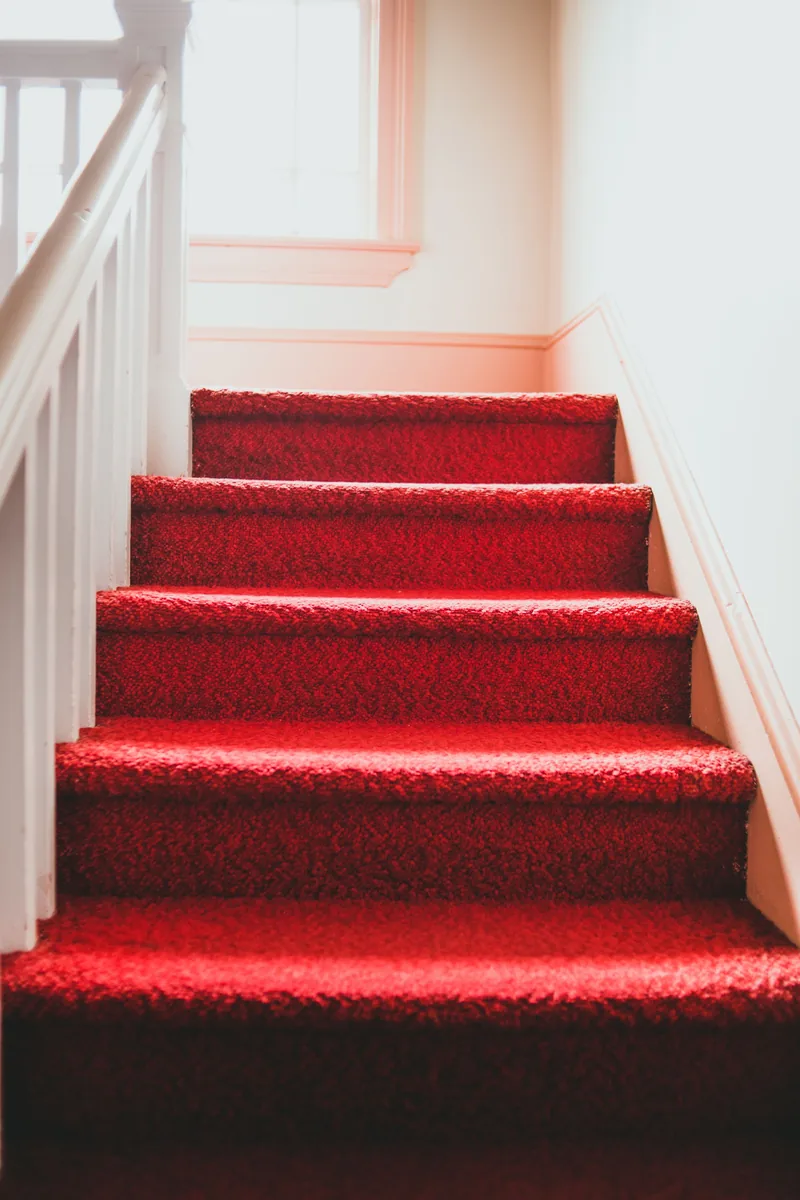
Stairs are the hardest-worn surface in any house, because every foot lands in the same three inches of every tread. They deserve the most durable fiber and the tightest twist you are buying, even if that means a different carpet from the bedrooms they connect.
There are two ways to carpet a stair:
- Cap-and-band wraps the tread and the riser separately, and looks tailored.
- Waterfall carries the carpet over the nose in one sheet and is simpler.
Either way, it has to be pulled tight and fastened at every tread. Where carpet meets a hard floor at a landing or at the top of the stairs, it is finished behind a nosing so the edge is protected. If you are thinking about taking the stairs to wood instead, carpet to wood stairs walks through that.
What to ask before you order
- What is the density and weight of the pad, and does it meet the carpet manufacturer's specification?
- Is the old pad being replaced? (It should be.)
- Will the carpet be power stretched, or kicked in?
- Where will the seams fall, and which way will they run?
- For a pet household: is the pad a moisture barrier, and is the fiber solution-dyed?
For what carpet costs and what drives the price, see carpet flooring cost.
Getting it measured
We bring carpet and pad samples to the house so you can judge them in your own light, and we plan the seams at the measure. The estimate is free, the installation is done by our own crew, and the labor carries a one-year warranty. Book your estimate here.